
Mike McKeown, Games Workshop and the (lost) Tower of Despair
Games Workshop. Today a large company in charge of, among other things, the Blood Bowl game and the behemoth IP that is Warhammer and Warhammer 40K. Movies, video games, magazines, merchandise... probably some candy somewhere, too. My kids love staring at their beautiful (if startlingly expensive) table top games in the specialty stores, while their dad sneaks off to buy some of the company’s terrific (if startlingly expensive) Citadel miniature paint.
Games Workshop was founded in 1975 by John Peake, Steve Jackson and Ian Livingstone, the latter two well known for their Fighting Fantasy (and Livingstone of course for being the mastermind behind Eureka!)
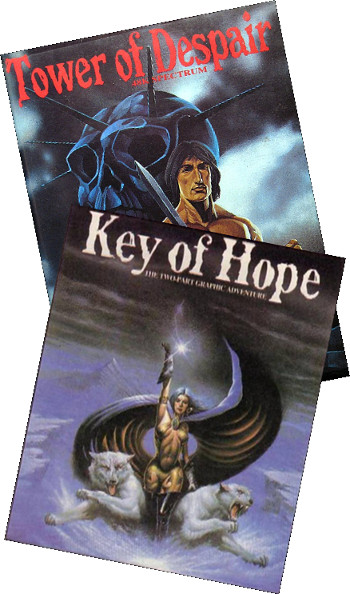
The company is not particularly famous for its adventure games, but it did in fact produce a few. Key among these were Tower of Despair, a highly atmospheric fantasy game with a sequel, Key of Hope that appeared to have vanished into thin air. How and why did a company such as Games Workshop decide to get into computer games? I was intrigued, and after some searching I came across Mike McKeown, one of Tower’s designers. Mike turned out to be a very friendly chap, but he started off claiming to have forgotten most things, so I was interested to see where this was going.
Mike was born in Derbyshire "in the early space age - 1961" and received a degree in Astrophysics from Queen Mary College University of London. And then it was on to the games industry...
I know that this is many years down the road. But I‘d like to save as much as possible for posterity.
There's not a lot of info available on the "behind the scenes" of Tower of Despair. And I'm sure there must be something, seeing how GW was a major company already at the time. So.... how did you get involved with them, for instance?
I first worked at Games Centre and then at Games Workshop which is how I came to be (briefly) a games developer. Tower of Despair was written in our spare time while we were working for Games Workshop in other capacities. Russell Clarke and I were in the warehouse, having just graduated from University. Jamie Thomson was a staff writer for White Dwarf magazine, and Steve Williams worked in mail order.
How come they suddenly decided they wanted a software arm?
I think what happened was that someone approached GW with the idea of converting their board game Battlecars into a micro computer game, and they decided that they’d like creative control and were looking about for a couple of other games for an opening slate of titles.
They’d already let the ball drop a bit with the Fighting Fantasy game books by letting Puffin publish it when they were already publishers in a way.
Ah, makes sense. And it was a really nifty game, too – although the font wasn't very user friendly!
The font was my idea, but the limitations of an 8x8 pixel grid made a cursive font a challenge to design. We wanted to make the screen look like a printed book. So the actual writing often involved word and sentence choices that would allow the text to appear justified on screen - I would add in the odd double space to make it fit better but would often change wording to avoid short lines in the middle of paragraphs.
Did you decide on making several games in the series right away or did that come up later on?
The original idea for the game was a single title outlined by Jamie. When it seemed to be a success, Russell and I plotted out the story to be a trilogy - we used a set of rooms in the first game as inspiration for titles and so Key of Hope and Champion of Destiny were outlined and shopped back to GW.
I've never heard of the latter title before - fascinating.
Meanwhile Battlecars and D-Day were also a success and we were commissioned to make a C64 version of Tower and D-Day - both of which we did. Another team did a port of Tower onto Amstrad CPC at the same time.
We had written Tower using the Quill utility and we had to get a custom version of it made in order to do the font in C64 ...
It seems like a quite ambitious plan for a new software label, but I guess they had the financial muscle to make it happen.
GW had big plans for a short time, with a new guy - Angus Ryall - brought in to market the games.
We did a bit of machine code in the background and hid some of the quirks that would have made it look like every other Quilled game. But the Quill was an excellent engine at the time and that let us focus on the story, and the logic.
Yes, it's a very versatile tool indeed.
Tower was also big - I think it was the first Spectrum adventure which was really two games - you had to save at the end of part one and turn the cassette over and load your game into part two. A lot of the objects and verbs from part one were destroyed and/or repurposed to get round the 255 item limit.
And we had a lot of secret synonyms - where we thought you’d never use both words to try the same thing. I remember just one - PASS(AGE) was the same noun as TREE.
Well, that's forward thinking - so many games back then didn't have much in the way of synonyms.
We wanted the game to seem as intelligent as possible. Finding the exact right two words was a huge source of frustration to me as a player. We did have to pay a price for that - we had no room for any HELP in the first half of the game.
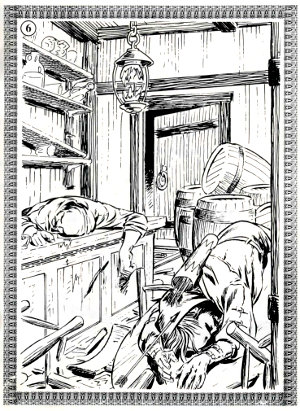
And no images, but that worked as sort of a copy protection, I suppose.
Yes, the 16 pages of artwork contained items not referenced directly in the text to act as clues.
Plus, our team was awful at computer graphics anyway.
Haha. And quite possibly The Illustrator wasn't even out back then?
No, it wasn’t. We did get someone in to do vector graphics for Key.
As I recall The Illustrator was published some time after The Quill.
Yes, it came out later. What killed GW’s nascent computer games division was something really stupid… The guys who wrote D-Day made a version for Sinclair QL. The QL had a unique looped tape drive with fragile and expensive cartridges.
Sounds like a recipe for disaster?
Ian Livingstone and Steve Jackson were early adopters and thought it was the next big thing and that GW could become THE QL gaming house. So they ordered a big print run of D Day.
The developers, meanwhile, forgot to tell anyone that their game wrote back to the micro drive constantly. So when the game was put out, with the standard commercial protection for tapes, the cases had no write protection tabs. So the game was broken.
And since the division had to be self funding, each release was as to pay for the next.
Meanwhile Citadel Miniatures was making a reverse takeover bid for GW and bought out Ian and Steve. All the money went to Warhammer and moving head office from London to Nottingham. No more computer games division ... poof.
And really, the writing was on the wall for commercial adventure games. SSI was developing Pool of Radiance and computer RPGs were on the way.
Well, commercial adventures did at least so-so for another couple of years. But yes, they had probably peaked at that point. How were sales of Tower, then?
We had good royalties for a couple of years. I think the four of us made a couple of thousand each, which was a nice bonus at the time.
It probably sold around 7-8 thousand copies - GW gave us 10% royalties, more than most software houses. Ian and Steve made that on their gamebooks and thought it was standard.
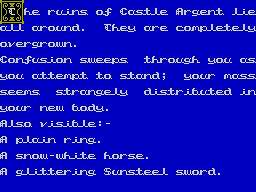
And as for Key of Hope, which I've pestered every Speccy emulation site about for the last 15 years.... you said it didn't make it to publication. But it seems that it was in an advanced state at least, as review copies made their rounds.
I think we’d pretty much coded it up and we were in play testing.
There even was one with a very Quill-looking screenshot…
Yep - it was a time travel based quest, but it’s all lost in the mists of time - we were trying to move away from the “generic high fantasy” of the first one.
We had time travel via the spirit of the protagonist entering the bodies of his descendants. So Key of Hope was actually going to have you experiencing things from a female POV - quite an early example I think for gaming. You can see the first hint of that in the comment about the protagonist thinking their mass was “strangely distributed” in the screenshot.
So the $64,000 question is: might anyone have a playable copy lying around?
No. Pretty sure not. I don’t and I was lead coder. I don’t even have a copy of Tower any more.
Okay. There's still a slim hope that a reviewer might come up with something some day. But all in all, a shame! So that ended your adventure endeavours?
Yep - I doodled a couple more but needed a good job and went into mainframe programming for businesses instead.
Man's gotta earn a living.
Wife, children, and now it’s almost 35 years later. I still have some paper notes for what my next game was going to be - “The Dying of the Light” - which would have been a world hopping adventure, a sort of noir meets Lovecraft thing to prevent alien space bats emerging from their slumbers to darken our skies for all eternity.
But I think others have done these things better in the intervening time
With all the tools available these days (modern Quill equivalents etc., game coding has never been easier.
You know, Mike, for a chap who professes his lack of memory, you're doing awfully well.
It was a fun time - more fun than being a PMO Manager at a bank, anyway.
These days the closest I get to that is writing automation VBA in Excel and putting the macros onto a custom ribbon ...
Well, somebody actually wrote an adventure game in Excel VBA. You just need to sneak in the right code bits when nobody's looking! Anyway, once again thanks for helping me out.
Ok - it’s nice to be remembered!
- Jacob Gunness, May 2018
Images courtesy of John Metcalf