
Twin Kingdom Valley - on the move
Back in 1999 I had a word (a few, actually) with Trevor Hall, creator of 1983's Twin Kingdom Valley. The game was one of the pioneering efforts in the field of adventure games, since it featured "live" characters that roamed about in the game world. Now, almost a quarter of a century later, the game has been ported to mobile phones, allowing you to combat mighty foes and solve devious puzzles - text style. All while sitting on the bus, the beach or whereever you're off to. I've talked to Trevor again and also to Ian Pare, the driving force behind the new version, which can be bought here.
Trevor, to what extent have you been involved with the new version, apart from giving a go ahead?
I've done lots of tech support, plus game extensions, plus lots of new graphics. I didn't do any actual "game engine" code, but I did do some new "graphics engine" example code.

How did it feel to revisit it after 23 years? Certainly game design has changed quite a bit over the years
Well, not this design....but it's much easier to edit now.
Yeah, I guess it takes a lot of the fidgeting back and forth with bits out of the programming. But actually, I meant adventure game design in general.
I don't know much about what others have been doing in the field. I exited that work over 20 years ago. So I don't have much opinion about that. Of course, I've played some newer games (100s of them) though....
Ok. Why do you think that Silicon Magic was attracted to your particular game?
I don't really know why, except from the fact that the project seemed to be a good fit for cell phones, and was a hit when first launched. Furthermore, the coder had played the game before.
Now for the $64,000 question: The average IF/adventure gamer is probably one that spends 5 minutes typing a simple message on a cell phone. To what extent has the interface been adapted to fit our ageing fingers?

(click to enlarge)
Here is a simple screenshot of the graphics design tool. It has lots of features,
all written in C#. The old tool was just a text editor for the BBC micro. The
result: the new design tool gets images done 10 times faster. I had to reverse
engineer the whole thing to import the original graphics (from the C64 version).
The interface: Wonderful! Perfect predictive text.
Since the game has a limited vocabulary, every word can be typed "as is" without
caring that there are multiple letters on a key. Most words complete after
3 keystrokes. Directions (like "N" for north) are, or course just
1 key.
Ah, beautiful!
Example: 376 = drop (you enter dro and then the "p " adds itself).
Ok, that's pretty neat
Once again thanks to Trevor for taking some time out of his tightly packed schedule to have this talk with me. Another interview has appeared on the Edge Online website. Have a read here.
Jacob Gunness, July 2006

Ian Pare of the British company Silicon Magic has been the man responsible for getting the mobile version of the program off the ground:
Yes, I am the lead on the TKV project; in fact the mobile version is really my baby. I have for a while wanted to do an adventure game project on a mobile phone, but didn't really know anything about the workings of an adventure game. So I remembered TKV from playing on a friend's BBC micro back in the early 80's, and thought, as it was quite a revered game, I'd try to do a conversion.
The first problem was: no source, just a binary... so armed with my copy of Rodnay Zaks' "Programming the 6502" and a dis-assembler, I reverse engineered the game to give me full 6502 source, which helped me understand how the game worked. Then it was a case of translating to Java, and getting a prototype running on a phone.
Once I'd got to this stage, and was happy I could make the project work, I contacted Trevor Hall, and told him of my idea and looked for his approval / license. Which he enthusiastically gave, out of astonishment I think, that someone had gone to such lengths. (Actually this was the riskiest stage: he could have quite easily said no!)
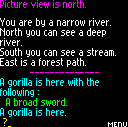

From then on it was full steam ahead, building the game, modifying the format
to fit the limitations of a mobile device, building a predictive text engine,
and the game shell. Meanwhile Trevor became actively involved, modifying the
graphics commands to make the images look better on a 128x128 screen. In addition,
he fully helped test and debug the game, making sure all the non-player character
AI worked correctly.
I wanted to make the mobile version more of a challenge to people who had
already played the game, so I wanted to extend it... and who better to ask to come
up with the new puzzles & locations but... Trevor Hall. Trevor designed
the new game elements, which are now part of the Mobile version.
BBC Micro: 176 locations
C64: 190 locations
Mobile: 200 locations
So there you have it, the project life cycle in brief.
The game was released on the 10th of August on the Nokia 6230 & 6230i,
we are currently busy converting it for other phone versions.
From a technical standpoint, how difficult is it to convert the game for the various mobile platforms?
It’s not too difficult to do the conversions to other mobile platforms.
The main problem is getting the game to run in the available “Heap” memory,
which varies from device to device. Because the game is such a large adventure,
with graphics for each location, and given that we have extended it further,
once all of the stuff is loaded in to memory, together with things like menus,
screen buffers, predictive text handling routines and the overhead of the Java
libraries, it’s easy to blow a couple of hundred K.
The application size is around 64k. People may say, “64k, how come? The
BBC micro only had 32k RAM of which about 20k was usable.” But the mobile
version has a menu system, with background, 256 colour splash screen, and the
BBC had its own input and text screen handling routines built in to the ROM,
but we’ve had to develop these routines ourselves to make the game work
in a mobile phone.
Since it's been a long time since traditional text adventure games have been considered economically viable, I'm really pleased to see that there are still enthusiasts out there who are willing to perform a leap of faith.
It is our intention to make the name Silicon Magic synonymous with mobile
adventure games, just like Infocom and Scott Adams were on the 8-bit micros,
so I thank you for your support.
We are currently busy converting the game to run on as many mobile devices
as possible. As you say, it has been a leap of faith, but the comments we have
had back so far have been very positive. If this game proves a success, we
are planning a sequel, which I know Trevor always thought about doing.
Thanks to Ian for participating!
Jacob Gunness, August 2006
the original and new versions
of Twin Kingdom Valley